Blog Archive

Wednesday, August 31, 2005

The Wall


....
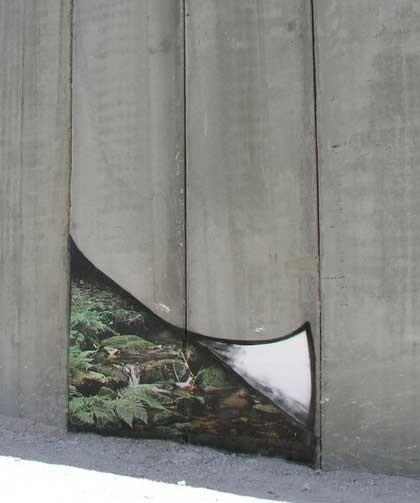
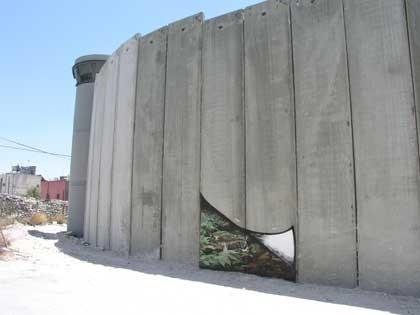
British artist Bansky recently painted Israel's West Bank security wall with satirical images of life on the other side. Bansky created nine paintings on the Palestinian side of the barrier.

Banksy is from Bristol in Britain and never allows himself to be photographed. .......

A Ramallah resident approached the painter while he was working on these scenes and said, "You are painting the wall and making it beautiful." "Thank you," the artist replied. "We don't want it to be beautiful. We hate this wall. Go home."


For more details check the bbc site

or

Crisis pictures.org

Monday, August 29, 2005

A Royal Dream


Together with Lord Avebury and a 'disenchanted group' from Bahrain


My opening remarks at the seminar on "Bahrain: 30 years of unconstitutional rule" chaired by Lord Avebury the Vice-Chairman of the Parliamentary Human Rights Group, at the House of Lords, (1 Abbey Gardens, London SW1), 25th August 2005


………
……..
Let me begin my remarks by a positive reference to a speech made by the king of Bahrain last February. The speech, “I dreamt of a homeland that embraces all its citizens”, provides glimpses of how sheikh Hamad perceives himself and his role as a person whom destiny and history have charged him with a mission he defines as ‘moving the country forward.

Unfortunately, and in spite of all the creative public relation endeavours, sheikh Hamad’s performance as a nation-builder remains abysmal. At least it is not anywhere near the hopes many of us were led to believe when sheikh Hamad announced in 2001 his intentions to take up the challenging tasks of reforming the dynastic rule in Bahrain and to build a country where citizens, regardless of their backgrounds would enjoy equality in rights, privileges and responsibilities.

Sheikh Hamad ignores the fact that his dream of a land that embraces all its citizens will remain a dream as long as he adamantly refuses to deal with what I call the legacy of the conquest. This legacy refers to 1783 conquest of Bahrain by the al-Khalifa family and its tribal allies from the mainland Arabia. To this day, the ruling family in Bahrain, and of course sheikh Hamad himself, refer to that conquest as the basis for establishing the legitimacy of their dynastic rule. I am not talking here about few symbolic signifiers of this legacy such as titles or demeanours. No. The legacy of conquest is to be found in the real world of politics and business. It is to be found the daily experience that any al-Khalifa person whether senior in rank and age or not, is above the law. The legacy of conquest is found in the monthly stipend of thousands of pounds given to each and every member of the al-Khalifa. It is to found in the songs and poems that Bahrain children learn to sing and recite acknowledging the conquest as an act of historic salvation. And in the monuments constructed to tell parts of the inhabitants that they are victors and tell the others that would remain the vanquished. The legacy of conquest is found in the submissive acknowledgement by an employee, professional or otherwise, that a priority in appointment and in promotion is, naturally, reserved to one’s al-Khalifa colleagues. I can of course go on into more examples and details.

Sheikh Hamad has not only refused to address these day-to-day manifestations of the legacy of conquest but he has indeed expanded them further. During the past five and a half years sheikh Hamad has done a great deal to consolidate this legacy and consolidate the feudal privileges enjoyed by his siblings. In fact a process of Khalfanisation of the state initiated by him has putting an al-Khalifa person on the top of nearly all government and public institutions in Bahrain.

The poor performance of Sheikh Hamad as a reformer and a nation-builder does not surprise observers of Bahrain’s political development and students of its recent history. The tremendous tasks that Sheikh Hamad pronounced his intention to undertake required overcoming serious obstacles. Sheikh did not succeed because he was unable, and I am tempted to say unwilling, to pay the price of reforms. A price that would require him to take straight on some of the persisting obstacles to reform and to nation building.

In May 2001, three weeks after my return to Bahrain following 25-years in forced exile, I delivered a public lecture in which I pleaded to sheikh Hamad that he addresses some of the most obvious and most immediate of these obstacles. Unfortunately he chose to ignore that plea as well as other pleas made by so many concerned Bahrainis. Sheikh Hamad’s unyielding position has complicated an already very complex situation in Bahrain and may frustrate all attempts to bridge the widening gap between the diverse political, religious, ethnic, and other segments in Bahraini society.

Another reason for the abysmal record of the reform project in Bahrain is found in Sheikh Hamad perception that reforms are nothing more than a series of makramas, royal grants, aimed at securing allegiance and support. Relying on makramas seemed to work for a while as it helped appease some of the leaders of the opposition. Unfortunately sheikh Hamad ignored every warning sign that generous grants cannot be a viable alternative a thoroughly work-out strategy of reforms.

In spite of past failures, Sheikh Hamad continues to view the reform project as his own private initiative. It is his grand Makrama. He remains reluctant to consult with any of the political groups on any aspect of the stagnant political process in the country. On he has the power to draw the contours of the process, to chart its future, its perimeters, its intensity and its extent. Indeed, through his political and financial makramas the sheikh continues to insist that he, and he alone, who determine what social group or political network, is to be included in the public sphere.

Let me end these remarks by going back to the royal speech of last February where sheikh Hamad where speaks of his dream of a homeland that embraces all its citizens”. Unfortunately for sheikh Hamad and for the people of Bahrain, he went the wrong way to fulfil that dream. His dream is turning into a nightmare for his people.


An Arabic version of the the above can be found here


____________________________________________________

As usual all presentations will be published by the organizers. For a recording of the whole event check here
_____________________________________________________________


Friday, August 19, 2005

Leaving for London


This weekend, I will leave for London to attend the seminar chaired by Lord Avebury, the Vice-Chairman of the Parliamentary Human Rights Group, on Thursday 25th August 2005.
According to the invitiation the title of the seminar is : Bahrain: 30 years of unconstitutional rule

It will be exciting to meet Lord Avebury, a good friend of Bahrain and the Bahrainis, and all the other people who follow different aspects of political developments in our country.

The seminar will also be a good occasion to discuss with representatives what an aditor of a Bahrain daily calls “disenchanted Bahraini groups”.(the Arabic version of this editoral is more confused).

Like many post-colonial persons of my age, I love to visit my ex-colonial metropole. But a particular joy has been added to my visits to London since the mid-1990s.

I now realize that I enjoy a pivilge of sort. I can visit the UK any time I choose (at the discretion of my employer and the British consular services). But Bahrain’s prime minister cannot. Nay, thanks to the development of Ian Henderson case, our PM dares not even think of such a trip. There are many of us who wish he does.

In a way I feel good every time I pass through Heathrow and recall that the mighty PM of Bahrain cannot . For Khalifa bin Salman the nearest town to London is Dublin.


Here is an enchanted Bahraini person preparing himself to undertake a journey that his former tormentor cannot undertake.

See you in ten days.


Thursday, August 18, 2005

A well deserved word


في عدد أمس من جريدة الأيام كتب الأستاذ عقيل ســـوار في عموده اليومي هواجس كلاماً جميلاً في حق واحدٍ من خيرة فناني البحرين الذين أهملتهم و أهملت مواهبهم و إنجازاتهم سياسة النظام القائم في البحرين و هدرت ما يمثلونه من ثروة بشــرية . تماماً كما هدرت و تهدر ثروات أخرى مادية و بشــرية في بلادنا التي تعتبرها مزرعة خاصة بأولاد وبنات العائلة الحاكمة.

فيما كتبه الأستاذ عقيل ســـوار , أبو مازن, تحت عنوانٍٍ يعبر عن معنٍ كثيرة : عملتنا الستينية، المهدورة! , يبرز الأستاذ ســـلمان زيمان , أبو ســلام , الفنان الملتزم الذي " لا يتردد عن تلبية أية فعالية وطنية، ولا يغني نظير أي شيء إلا لحاجة وطنية أو فنية، لا تربطه علاقة رسمية لا بالحكومة وهيلمانها في وزارة الإعلام، ولا بالمعارضة وهيلمانها في الجمعيات السياسية، لكنه مثل أية شخصية ستينية النشأة، يمشي مخفورا بهموم الوطن والجمعيات وبأحزان السياسة اليومية. إنه فنان البحرين الأسمر، الذي تذكرني سمرته ووسامته المحرقية، برجولة »يزوة« سفينة غارقة، وصلوا ساحل النجاة بعد مكابدة،وتذكرني مسحة الحزن في صوته بأنين صواري سفنهم قبل انكسارها بقليل، إنه بأحسن ما أعرف من اختصار، عملة بحرينية ستينية، نادرة.. ومهملة!!

إنه سلمان زيمان الذي ندرته، و»إهماله«، يحكيان ببلاغة لا تحكي مثلها عشرات المقالات والندوات والخطب والقصائد، مأساة البحرين، إذ تقصي وتتنكر لتاريخها وأعلامها وفنونها ومبدعيها ومشاعرها.
لطالما اعتقدت ودافعت عن اعتقادي بخصوصية ومواهب الفنان الحزين المسالم (أبو سلام) وعن انسجامه مع عائلته الزيمانية الموهوبة المخذولة، لأنهم يمثلون ثروة وظاهرة بحرينية، لا تتكرر، هدرتها البحرين الرسمية بانشغالاتها عن الفن والفنانين، بالطبالات والطبالين (لا إهانة لطبل أو طبال!)، والآن تخذلها البحرين الشعبية بعصبياتها وتنكرها لمشاعرها، إذ تطرب في السر لسلمان وخليفة ومريم وهدى، وباقي الظاهرة الزيمانية النقية التقية الجميلة، وتحتفي وتصفق في العلن »للرادود« الفلاني والمنشد العلاني.. مع أن سلمان منا، أهل البيت البحريني! "


لقراءة عمود أبي مازن ضغط هنا


لســـماع بعض إنتاج أبي ســـلام إضغط هنا


Wednesday, August 17, 2005

Photostory: Burj el-Shemali Refugee Camp - Lebanon


Photostory: Burj el-Shemali Refugee Camp - Lebanon
Stefan Christoff, The Electronic Intifada, 14 August 2005

Burj el-Shemali is a Palestinian refugee camp located in Southern Lebanon on the outskirts of the city of Tyre. Upwards of 20 000 refugees reside in Burj el-Shemali, which is one of Lebanon's most impoverished camps. Burj el-Shemali like other camps in the south such as Rashidieh Camp is home to cases of extreme poverty, thousands of camp residents are essentially homeless, residing in make-shift shelters with zinc roofing, without basic plumbing, water supply and little income.


To view an extended photo essay on Burj el-Shemali camp from the Independent Media Center of Beirut visit Indymedia Quebec.


To visit the official website of Burj el-Shemali refugee camp click here.

Bahrain: 30 years of unconstitutional rule


Lord Avebury
the Vice-Chairman of the Parliamentary Human Rights Group
Cordially invites you to a seminar on
Bahrain: 30 years of unconstitutional rule
A spectrum of speakers will take part in the seminar, Bahrainis and non-Bahrainis, including political and human rights activists, journalists and academics
11.00 AM, Thursday 25th August 2005
1 Abbey Gardens, London SW1 (Annexe to the House of Lords)
For further information please contact: Lord Avebury on 020 7274 4617


On 26th August 1975, the former ruler of Bahrain suspended the contractual constitution and dissolved the elected parliament. The country has since remained under the absolute power of the ruling Al Khalifa dynasty. As the country prepares to host the Forum for the Future, questions are asked about the volatile political situation in Bahrain


Tuesday, August 16, 2005

DEJA VU.

for more pictures


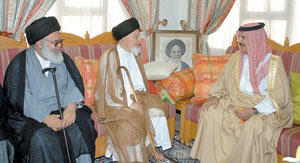
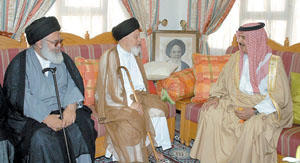
HM hails senior clerics (Tuesday, August 16, 2005)


The Bahrain Tribune reports that HM King Hamad, yesterday visited the head of the (the Sunni senior cleric) Sheikh Ibrahim bin Abdullatif Al Saad, and his family at his home in Al Fadhel district. HM the King also visited another senior cleric (Shia) shiekh Jawad Al Wadaie at his residence in Bar Bar village.

The report notes that sheikh Saad hailed the King's constant efforts to serve religion, Islam and Muslims.

On his part, Sheikh Abdullah Al Guraifi (speaking for Al Wadaie ) also hailed the success of HM the King’s reforms.

According to the Bahraini daily, the King stressed the role of religious scholars in unifying the community and promoting the sense of brotherhood in the community and supporting the reforms for the benefit of the country.


Have we been there before? Five years ago? Fifty years ago?

___________________________________________________________________________


“Clerics-ruling family relationship continues in spite of occasional rupture caused by activities of underground religionist groups, including the young graduates from seminaries in Cairo, Najaf and Qum. For clerics, the relationship provides them not only with access to the centre of power but also provide with enough goodwill to intercede on behalf of their own restive constituencies. Benefits secured through such intercession range from securing employment, housing loan or a plot of land, to release from detention. The influence of these clerics has led to an absence of any active protest in some rural areas and residential quarters throughout the recent troubles that raged in rest of the country since 1994. This supports Khuri's observation (1980:241) that " 'tribalism' as a form of social organization and religionism as a political force reinforce each other. (italics mine)

From “THE NEW AMIR OF BAHRAIN: MARCHING SIDEWAYS
CIVIL SOCIETY, VOL. 9, No. 100, APRIL 2000,
_______________

HM recent moves, notwithstanding loud noises heard here and there, underline the premises of the observation above.
Monday, August 15, 2005

old posts

for older posts check
http://jaddwilliam.blogspot.com/

Still waiting


Will HM say something substantial this afternoon?